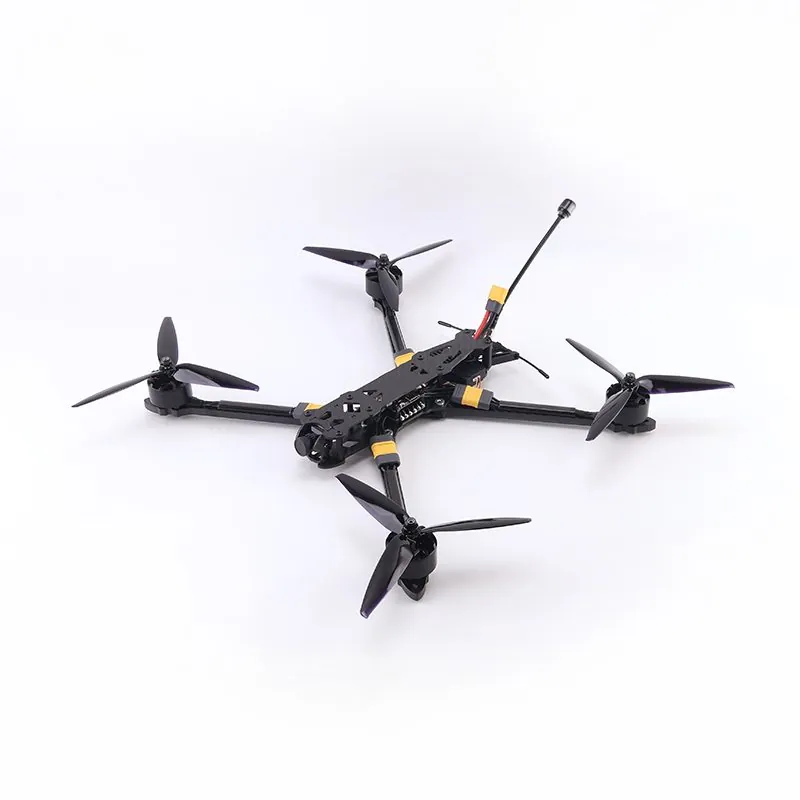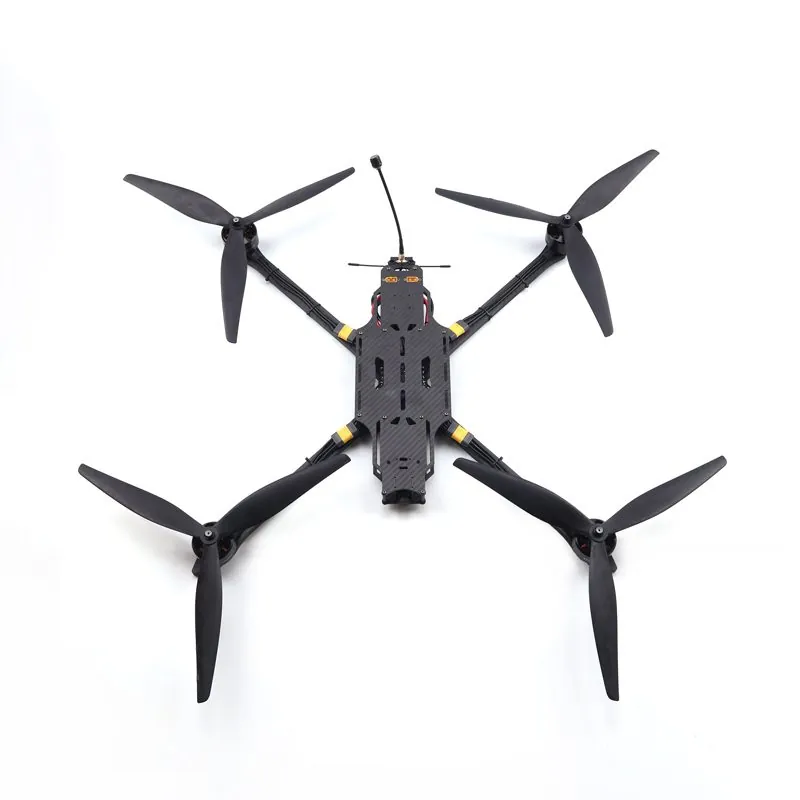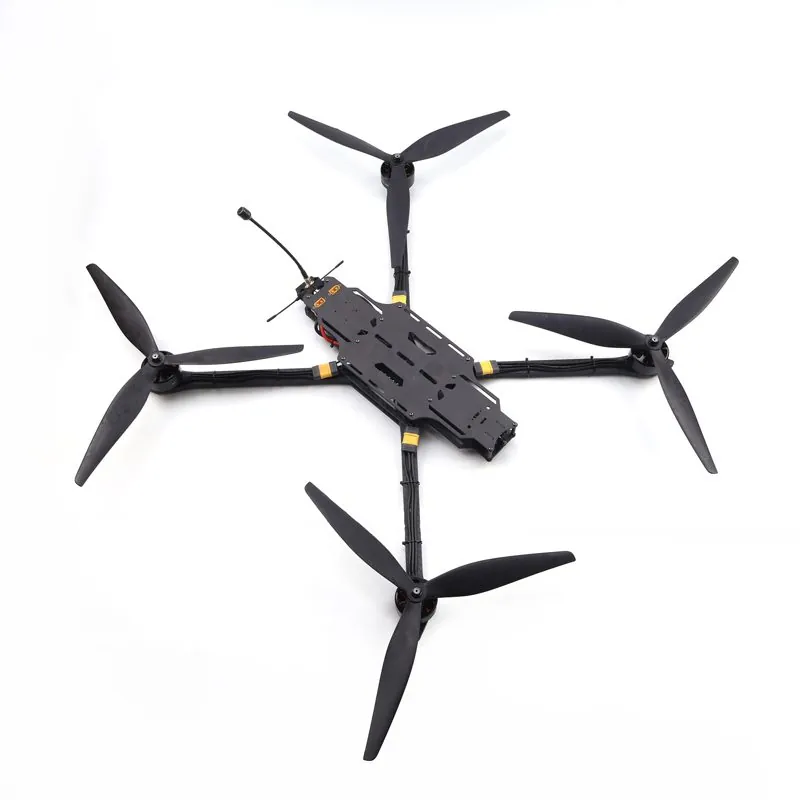
An 8 km inspection route. The aircraft launches on a full battery and has to turn around at the 4 km mark, or it will not make it home. The link is still at full bars. The battery is the one raising the alarm. That is the most common way a long-range FPV mission goes wrong, and it is also the easiest trap to walk into when the flight plan is built from a spec sheet.
The root of it is that one word — range — is doing two jobs at once. What a manufacturer prints is control range: how far the radio and video signals will hold reliably. What you actually need in the field is mission radius: the farthest one-way distance out, work, and back. Those are two different numbers, and between them sit three conversions — loaded flight time, cruise speed, and return margin. Not one of the three appears anywhere on a spec sheet.
The advice we give customers is one sentence. When an aircraft arrives, ignore the printed control range and start from loaded flight time. Control range is a communication limit; mission radius is an energy limit. Take the smaller of the two — and in almost every configuration we have worked on, the energy limit is the one that binds.
This article works through the distance account for long-range FPV: how control range and mission radius differ, why loaded flight time is the real ceiling, one radius formula you can apply directly, why the control link and the video link have to be calculated separately, which of the four sizes suits which task, and the four pitfalls that most often derail a selection.
Updated October 2026. Compiled from public sources and factory specifications.
Key numbers first (market context plus factory figures — a quick test of whether this is worth your time):
- The aerial FPV drone market is around USD 1.9 billion in 2026, projected to reach USD 4.8 billion by 2033 (CAGR 14.2%, Stats N Data; two other research houses put it at 14.9% and above 18%)
- Long-range FPV has moved from niche to routine: industry retrospectives describe it as a niche within a niche two years ago, while by 2026 a 10 to 20 km setup is standard for experienced operators. Over the same period, demand for HD video transmission modules rose 44% and interest in long-range communication rose 39%
- 61% of newly launched FPV drones already ship with AI-assisted flight — in this category AI is standard equipment, no longer a selling point
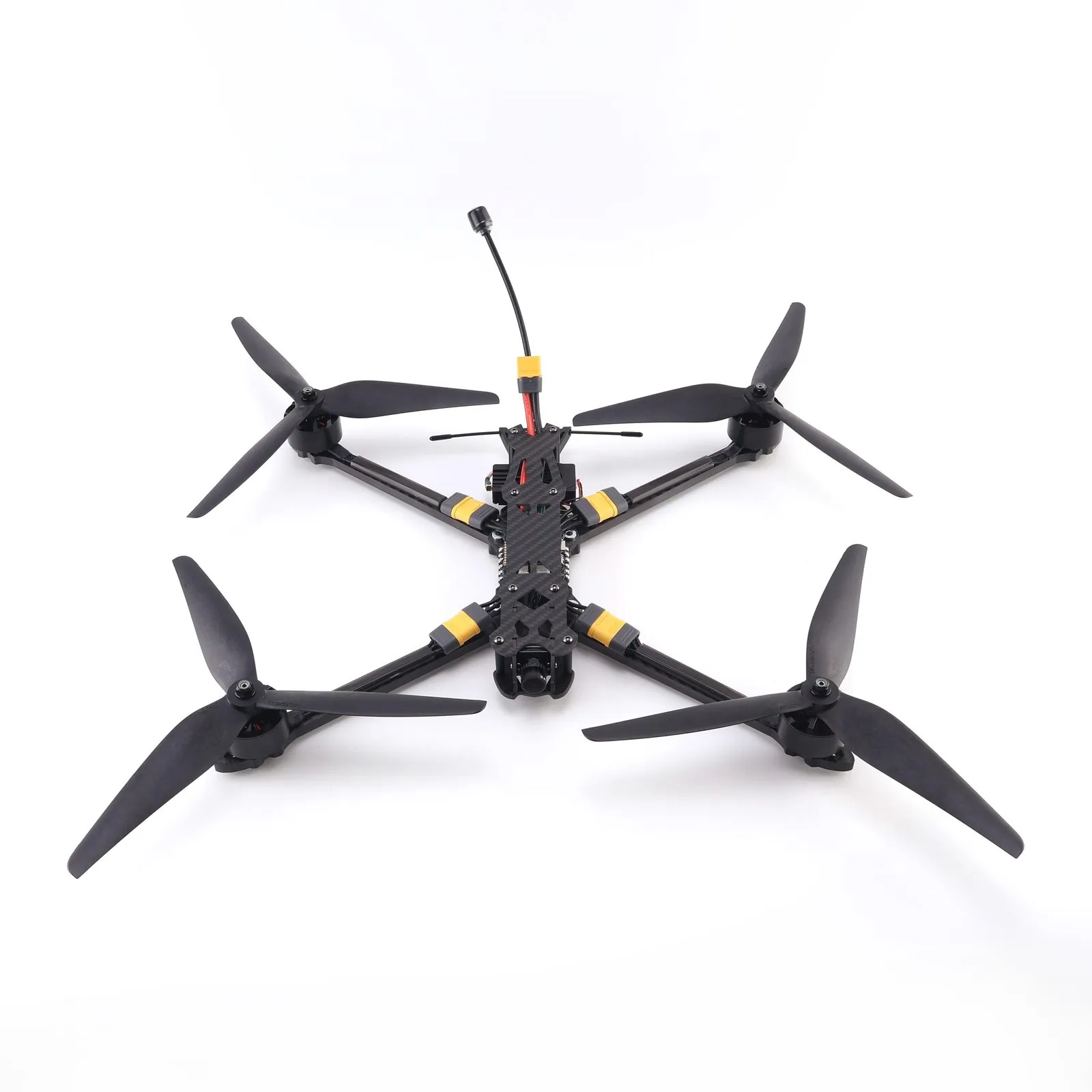
- Loaded flight time is short on all four: 7-inch 10–15 min (carrying 1.5–2 kg) | 10-inch 8–12 min (2.5–3 kg) | 13-inch 8–10 min (5–6 kg) | 15-inch 8–15 min (7.5 kg)
- Payload went up five times; loaded flight time did not move: maximum payload climbs from 1.5 kg to 7.5 kg, while loaded flight time stays somewhere in the 8 to 15 minute band
- One conversion you can apply directly: mission radius ≈ loaded flight time × cruise speed ÷ 2 × usable factor (margin is usually taken as 0.7)
- The control link and the video link are two different paths: ELRS 915 MHz carries commands, 4.9/5.8G 3W carries the picture. The two links do not cover the same distance, and the flight plan has to follow the shorter one
What a long-range FPV drone does: five real tasks
Put "long range" onto concrete tasks first, and the distance account afterwards has something to measure against. These five task types do not ask for the same kind of range. Some are limited by flight time, some by the link, some by neither — and knowing which one you are in matters more than memorizing the numbers.
1. Long-distance pipeline and line inspection
For linear assets — oil and gas pipelines, transmission and distribution lines, long water channels — the biggest cost item is how much a single sortie is worth. These projects are priced by the kilometer, so daily coverage per aircraft converts straight into a quotation. This is also the task type that cares most about flight time and least about pixels: the typical targets on a pipeline patrol — damaged insulation, corroded towers, illegal construction along the right-of-way — are already legible at 1500TVL analog quality. The payload budget is better spent on more flight time.
2. Large-area asset and terrain survey
Plant sites, mining areas, solar farms, coastal strips — wide-area census work is flown as a grid. How much ground one sortie covers depends on flight time multiplied by cruise speed, and has almost nothing to do with control range. Pushing control range to 10 km buys you very little here, because the aircraft has to turn back long before it gets there. The same area-based accounting logic appears in our agricultural crop protection drone guide.
3. Close observation at disaster and incident scenes
Landslides, floods, chemical releases, early-stage fires — the scene is usually somewhere people cannot easily stand. What long-range FPV buys you is letting the operator stay outside the hazard while the picture goes in, rather than sending a person closer. The sector-scanning logic in our desert search and rescue drone guide applies here too: carve the area into sectors by radius and work through them one at a time, instead of simply flying as far as possible.
4. Temporary aerial relay
In canyons, tunnel mouths and open-pit mines, a ground relay often cannot be placed where it needs to be. An FPV drone carrying a long-range control link can serve as a temporary airborne node, passing the signal down from altitude. This task depends on the 915 MHz control link rather than the video link — what matters is that commands arrive, not necessarily that the picture comes back.
5. Short- and medium-haul delivery of light cargo
First aid kits, small spares, sample containers — it looks like a task where farther is better, but it is really a task where the cargo is matched to the radius. A 7-inch carrying 1.5 to 2 kg and a 10-inch carrying 2.5 to 3 kg describe the payload ceiling, not a promise that the aircraft can fly a full endurance sortie at that ceiling. The delivery radius has to be derived from loaded flight time, never from the payload ceiling. The multi-payload combinations in our remote-area drone delivery guide are constrained by exactly the same account.
The distance account: control range is not mission radius
Separate the two kinds of range first
The figures manufacturers print get used interchangeably, though they point at completely different things. Every mix-up costs you one more planning error:
- Control / video range: the distance over which the link works reliably. Across the four models that is 5–10 km, 8–10 km, 10 km and 10 km. This is a communication capability.
- Mission radius: the maximum one-way distance you can fly out, complete the work, and return. This is an energy capability.
The two are equal in exactly one situation: when flight time is long enough to cover the entire control range and still have margin left. A 10-inch carrying payload has 8 to 12 minutes. That premise clearly does not hold.
The real ceiling is loaded flight time
Put the four side by side and a pattern shows up that is easy to miss: flight time did not grow in step with size, while control range hit its ceiling early.
| Model | Max payload | Nominal control range | Unloaded flight time | Loaded flight time |
|---|---|---|---|---|
| 7-inch | 1.5 – 2 kg | 5 – 10 km | 25 min | 10 – 15 min |
| 10-inch | 2.5 – 3.0 kg | 8 – 10 km | 30 min | 8 – 12 min |
| 13-inch | 5 – 6 kg | 10 km | 30 min | 8 – 10 min |
| 15-inch | 7.5 kg | 10 km | 35 min | 8 – 15 min |
Payload rises from 1.5 kg to 7.5 kg, and loaded flight time stays inside an 8 to 15 minute band the whole way. The reason is not hard to follow: a bigger airframe can lift more, but its battery, frame and motors get heavier too, and most of the extra thrust is spent carrying itself. "Move up one size and you fly farther" is an illusion — what a bigger airframe buys is payload, not radius.
The radius formula: three steps to a number you can use
Turning those figures into a radius takes one multiplication and one division:
Mission radius ≈ loaded flight time × cruise speed ÷ 2 × usable factor
- Loaded flight time: use the loaded figure, not the unloaded one
- Cruise speed: take the 12 m/s (about 43 km/h) order of magnitude typical of inspection work. The nominal 130 to 150 km/h is sprint capability, not cruise efficiency
- Usable factor: take 0.7, which reserves 30% for headwind, hover corrections and battery protection; drop it to 0.6 on a windy site
Substituting 12 m/s and a 30% margin, the four sizes come out as follows:
| Model | Loaded flight time (midpoint) | Round-trip distance | One-way radius | Usable radius with 30% margin |
|---|---|---|---|---|
| 7-inch | about 12 min | about 8.6 km | about 4.3 km | about 3.0 km |
| 10-inch | about 10 min | about 7.2 km | about 3.6 km | about 2.5 km |
| 13-inch | about 9 min | about 6.5 km | about 3.2 km | about 2.3 km |
| 15-inch | about 11 min | about 7.9 km | about 4.0 km | about 2.8 km |
[Needs manual verification]: the cruise speed and margin ratio in the table above are estimation assumptions, not factory figures, and a real project has to substitute local wind speed, terrain and take-off conditions. One more thing worth saying: the control range column took no part in this calculation at all, because it is not the bottleneck.
This table also explains a mismatch we see often. A customer plans an 8 km inspection route around a 10 km control range. The aircraft launches on a full battery and has to turn back at the 4 km mark, or it will not return. The link is still at full bars; the battery raises the alarm first. On proposals like this we recommend redrawing the route at the review stage, rather than waiting until the aircraft is airborne to work something out.
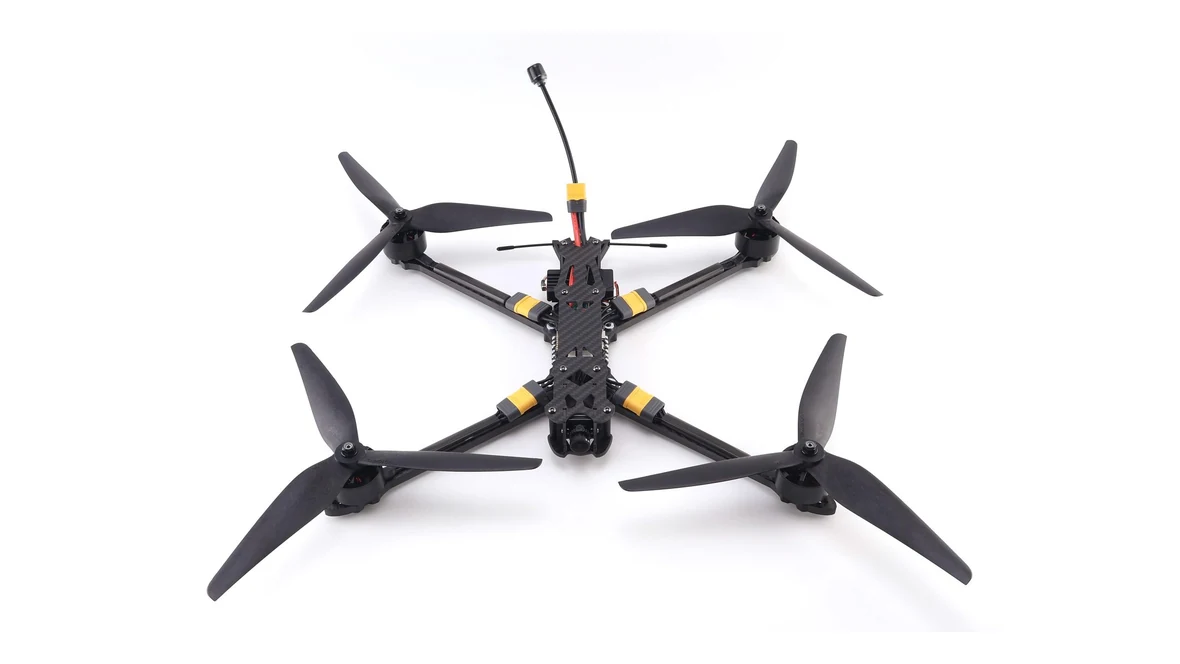
Control link and video link: where the 10 km figure comes from
915 MHz carries commands, 5.8G carries the picture
All four models use a dual-link design: control over ELRS 915 MHz (868 MHz also supported, selected according to the frequency regulations at the destination), video over 4.9/5.8G 3W. The two links are not the same thing:
- ELRS 915 MHz: a low band with long wavelengths, so diffraction and penetration are good — well suited to holding a command link under buildings and terrain. The protocol is CRSF, and the receiver weighs only 0.6 g without the antenna.
- 4.9/5.8G video: high bandwidth, so it can carry a clear picture, but weak diffraction, which means it drops earlier than the control link when something blocks it. 3W of transmit power with a 5.8G RHCP antenna is where this link gets its reach.
In real work the most common situation is control still connected while the picture is already breaking up. Plan a route around control range alone and you will discover the picture is gone only after the aircraft is out there. The planning radius has to follow the shorter of the two links, not the longer one.
Three conditions behind a nominal figure
The nominal 5–10 km and 10 km figures assume line of sight, low electromagnetic interference and a sensible antenna orientation. Break any one of the three and the measured distance will come in under the nominal figure:
- Terrain masking: in valleys, open-pit mines and dense built-up areas, the link degrades far faster than in open ground
- Electromagnetic environment: background noise near cities, industrial zones and telecom base stations compresses the usable distance
- Antenna attitude: when the aircraft banks hard or points away from the ground station, the radiation pattern falls off
So we treat the nominal figure as an upper bound, not as a distance the aircraft is guaranteed to reach. For a first sortie at a new site, we suggest planning at 60% of the nominal figure, verifying the link and the battery curve, and only then relaxing it. Customers often ask whether the video from this system can feed into their own ground station — and the answer to that depends on the specific link and the back end. It is not something a yes or no covers. Raising the interface requirement during selection is far cheaper than reworking it afterwards.
Review: four pitfalls that derail a long-range FPV selection
Of these four, the first costs the most and happens the most, so it goes first.
Pitfall 1: treating nominal control range as mission radius
Plan the route around 10 km, and the aircraft runs the battery down halfway, forcing a landing where it stands or an emergency return. Nominal control range is a communication ceiling; mission radius is an energy ceiling. Take the smaller of the two.
Fix: when a model arrives, work out the radius from loaded flight time first, check it against the margin, and only then ask whether the control range is enough.
Pitfall 2: estimating distance from maximum speed
150 km/h is sprint capability, not cruise efficiency. An FPV platform's power curve gets steep at high speed, so multiplying maximum speed by flight time produces a range figure that is clearly too high. The reverse does not work either: flying at the minimum speed gives longer flight time, but covers less route per unit of time.
Fix: estimate from a measured cruise speed. Most inspection tasks land between 10 and 15 m/s, so do not use the nominal maximum.
Pitfall 3: counting the outbound leg and forgetting the return
Tailwind out, headwind back is the classic way this goes wrong. The return leg usually draws more power than the outbound, and once battery protection triggers, the aircraft starts descending at the point furthest from the operator. Wind field differences are especially pronounced in mountains and along coastlines.
Fix: treat the 30% margin as reserved for the return leg and keep it out of the outbound plan; raise it to 40% on a windy site.
Pitfall 4: flying blind on memory after terrain cuts the link
Control intact, video gone, operator flying the last few hundred meters from memory — that is the typical script for this kind of incident. Flying low to the ground, terrain relief and buildings cut the video link earlier than expected.
Fix: mark high relay points on the route, keep the antenna oriented, and accept the constraint that the radius follows the shorter link.
In one sentence
The "long range" in long-range FPV is not the number of kilometers printed as control range. It is the 2 to 3 km that comes out of loaded flight time × cruise speed ÷ 2 × usable factor. All four models already reach or approach 10 km of control range, and the real difference between them is payload and loaded flight time: the 7-inch is the agile one, the 10-inch is the compromise, and the 13-inch and 15-inch are the load carriers. Choose the size from mission radius first, then choose the model from payload weight. Get that order backwards and you buy a configuration with enough link and not enough battery. For the full size comparison, see the FPV recon drone size selection guide; for the other half of the account — trading weight for flight time on the airframe — see how to split a micro gimbal SWaP budget.
We need your scenario
Whether you are a systems integrator, a distributor, or running your own pilot team on projects — send us a short description of your task (how far, how heavy, what terrain) and we will work the radius out from loaded flight time, then match the airframe.
- Systems integrators (inspection, survey, emergency work) → we work back from your route length to the flight time and payload combination you need, and specify the airframe and battery setup
- Distributors (unsure about size for a project in hand) → we fix the model against mission radius and payload weight, and send you the prototype configuration list at the same time
- Need a long-range model that is not in the catalog → use off-catalog sourcing: send us the task requirement and our domestic supply chain will configure it
How to reach us: leave a message on the site's inquiry page and mention "long-range FPV radius calculation". The technical team replies within 24 hours. Selection consulting is free of charge.
FAQ: Frequently Asked Questions
If the video link reaches 10 km, can I fly 10 km out and come back?
No. Ten kilometers is the distance the control and video signals can reach — a communication ceiling. Whether you can fly that far and return depends on loaded flight time and cruise speed. A 10-inch has 8 to 12 minutes loaded; at 12 m/s cruise with a 30% margin, the working radius comes out around 2.5 km, far short of the 10 km link distance.
Which of the four sizes has the longest flight time?
Unloaded, the 15-inch is longest at 35 minutes, followed by the 10-inch and 13-inch at 30 minutes each, and the 7-inch at 25 minutes. Loaded, the differences flatten out: all four sit in the 8 to 15 minute band, because a bigger airframe carries more payload and also weighs more, and most of the extra thrust goes into carrying itself. For selection purposes, loaded flight time is the more useful figure.
Which link drops first, control or video?
In most cases the video link. ELRS 915 MHz sits on a low band with good diffraction and penetration, while 5.8G video has high bandwidth but weak diffraction and degrades faster behind terrain or buildings. So when planning a route, the radius follows the shorter link, not the control range.
How do I work out mission radius myself?
Use loaded flight time × cruise speed ÷ 2 × usable factor. Take loaded flight time from the loaded value in the specification table; take cruise speed from the task's actual speed, with inspection work usually around 12 m/s; take the usable factor as 0.7 to leave return and headwind margin, dropping to 0.6 on a windy site. Of the three, cruise speed moves the result the most, so use a measured value.
How much flight time does loading the aircraft cost?
Based on the factory figures for the four models, loaded flight time runs roughly one third to one half of the unloaded figure: the 7-inch drops from 25 minutes to 10–15, the 10-inch from 30 minutes to 8–12, the 13-inch from 30 minutes to 8–10, and the 15-inch from 35 minutes to 8–15. Those are factory nominal figures; wind and temperature come on top of them in the field.
What is the difference between ELRS 915 MHz and 2.4G radio control?
915 MHz sits on a lower band with longer wavelengths, so diffraction and penetration are better and the command link holds up more reliably behind buildings and terrain — which suits long distances and obstructed environments. 2.4G sits higher, with more bandwidth but faster degradation, which suits close-range open flying. The receivers on these models support both 915 MHz and 868 MHz; confirm the frequency regulations of the destination country before purchasing.
Can these airframes carry a gimbal?
The airframe has reserved mounting points and can be fitted with a light EO payload to requirement; whether a given gimbal fits, and how heavy it can be, has to be worked out separately against the airframe's payload margin and power budget. Payload weight has a very large effect on flight time — see the "datasheet weight is not installed weight" part of how to split a micro gimbal SWaP budget. Before selecting, work out the installed weight of the payload first.
Disclaimer: this article is compiled from public sources and factory specifications. Cruise speed and margin ratio are estimation assumptions; refer to the supplier's latest specification sheet and measured data for final figures.